


The Advantages of Integrating a Brake Wheel on Your Fluid Coupling
2026-06-08 10:28The Advantages of Integrating a Brake Wheel on Your Fluid Coupling
In heavy industrial drives such as mining hoists, incline conveyors, cranes, and winches, the ability to start smoothly and stop precisely is as important as the power transmission itself. A standard Fluid coupling provides excellent soft‑start and overload protection, but it does not include a braking function. To stop the load, engineers traditionally add a separate brake disc or drum on the motor shaft or gearbox input. This adds complexity, cost, and maintenance points. The smarter solution is a Fluid coupling with an integrated brake wheel – a single unit that combines hydrodynamic power transmission and mechanical braking. This article explains the key advantages of choosing a brake‑wheel Hydrodynamic coupling over separate components, and why it is becoming the preferred choice for frequent stop‑start and holding applications.
What Is a Brake Wheel Fluid Coupling?
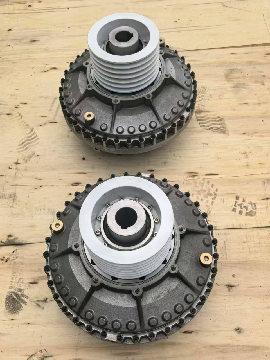
A brake wheel Fluid coupling is a constant‑fill or delayed‑fill Hydrodynamic coupling with a brake drum (wheel) cast or machined directly onto the output-side housing. The brake wheel rotates with the output shaft and can be stopped by an external caliper or band brake. Unlike a separate brake disc mounted on the motor shaft, the brake wheel is positioned after the Fluid coupling. This means that when the brake applies, the Fluid coupling continues to slip, absorbing kinetic energy and providing a cushioned stop. The result is much smoother deceleration than a rigid brake, with less shock to gearboxes and connected machinery. In addition, because the Hydrodynamic coupling limits torque, the brake wheel never experiences sudden overload spikes, extending friction lining life.
Five Key Advantages of the Integrated Brake Wheel Design
1. Smooth, controlled stopping – The Fluid coupling absorbs shocks during braking, eliminating the jerky stops common with direct‑shaft brakes. This protects belts, chains, and gear teeth.
2. Higher heat dissipation for frequent stops – The brake wheel’s large surface area, combined with oil splash from the Hydrodynamic coupling, dissipates heat much better than a dry disc brake. This allows more start‑stop cycles per hour without brake fade.
3. Fail‑safe holding capability – The brake wheel can be designed as spring‑applied, hydraulic‑released, so it automatically engages if power or pressure is lost. This is critical for hoists and incline conveyors.
4. Lower installation cost and space saving – A single integrated unit replaces a separate Fluid coupling plus a brake disc, caliper, and mounting brackets. The overall length is reduced, and alignment is simplified.
5. Reduced maintenance – Because the Fluid coupling limits torque, the brake wheel linings last 2‑3 times longer than those on a motor‑shaft brake. The integrated design also has fewer seals and bearings to inspect.
Ideal Applications for Brake Wheel Hydrodynamic Couplings
The integrated brake wheel Fluid coupling is particularly suited for:
Mine hoists and shaft winders – Precise stopping and fail‑safe holding are mandatory for personnel and material transport.
Overhead cranes and gantry cranes – Frequent start‑stop cycles and load holding require both smooth acceleration and reliable braking.
Downhill belt conveyors – The brake wheel provides controlled retarding to prevent belt overspeed, while the Fluid coupling dampens regenerative shocks.
Marine winches and deck machinery – Corrosion‑resistant versions of the Hydrodynamic coupling with brake wheel are available for offshore environments.
Large elevators and vertical lifts – The combination of soft start and positive braking ensures passenger comfort and safety.
Why Choose Dalian Mairuisheng’s Brake Wheel Fluid Couplings?
With over 22 years of manufacturing experience, Dalian Mairuisheng designs and produces brake‑wheel Fluid couplings that are fully compatible with existing brake actuation systems (pneumatic, hydraulic, or spring). Our Hydrodynamic couplings are available in sizes from 274 to 1150, covering power ranges from 5 kW to over 500 kW. We customise the brake wheel diameter, friction lining material, and actuation method to match your stopping distance and frequency requirements. Each Fluid coupling is dynamically balanced and tested for brake response time before shipment. We offer a 1‑2 year warranty covering both the coupling and brake components, and we ship worldwide in ISPM15‑certified export crates. Contact our engineering team for a free application review – we will calculate the required brake torque and propose the optimal Hydrodynamic coupling with integrated brake wheel for your duty cycle.