



Revolutionizing Material Transport: The Critical Role of Fluid Coupling in Modern Conveyor Systems
2026-03-30 09:31Dateline: March 30, 2026
In the relentless pursuit of operational efficiency and mechanical reliability within heavy industries, the humble conveyor belt remains the arterial system of modern material handling. From underground coal mines to sprawling port terminals and high-volume manufacturing plants, conveyor systems must operate continuously under extreme conditions. At the heart of ensuring these systems start smoothly, run efficiently, and withstand punishing mechanical stresses lies a device often overlooked but absolutely critical: the Fluid Coupling.
As industries globally push for higher throughput and reduced downtime, the application of hydrodynamic power transmission technology has evolved from a luxury to a necessity. For engineers and plant managers, understanding the nuanced benefits of advanced fluid coupling technology is key to optimizing conveyor performance.
The Mechanical Challenge of Conveyor Drives
Conveyor systems present a unique set of mechanical challenges. Traditional "hard" starting methods, such as direct-on-line (DOL) motors or simple mechanical clutches, often subject the drive train to brutal torsional vibrations and shock loads. When a long, heavily loaded conveyor is started with a direct drive, the motor must overcome the inertia of the belt, the idlers, and the material load instantaneously. This results in extremely high inrush currents that strain electrical networks and generate mechanical shock waves that propagate through gearboxes, pulleys, and belt splices.
These shock loads are the primary cause of premature wear in conveyor systems. Downtime caused by a snapped belt, a shattered gearbox, or a burned-out motor can cost operations tens of thousands of dollars per hour in lost production and repair costs. It is here that the fluid coupling demonstrates its indispensable value.
How Fluid Coupling Transforms Conveyor Performance
A fluid coupling—also known as a hydraulic coupling—is a hydrodynamic device used to transmit rotational power from a motor to a driven load, such as a conveyor head pulley. Unlike mechanical clutches that rely on friction, a fluid coupling uses a liquid medium (typically oil) to transfer torque. It consists of three main components: an impeller (connected to the motor), a turbine (connected to the load), and a housing containing the working fluid.
When the motor starts, the impeller accelerates the fluid. The centrifugal force throws the fluid outward onto the turbine blades, creating a vortex that gradually transfers torque to the output shaft. This process offers distinct advantages for conveyor applications:
1. Controlled Acceleration
The most significant benefit of utilizing a fluid coupling in a conveyor drive is the ability to decouple the inertia of the motor from the inertia of the load. By allowing the motor to accelerate to near its synchronous speed before torque is fully transmitted, the fluid coupling ensures a "soft start." This controlled acceleration eliminates the dangerous "snatch" effect found in direct drives, drastically reducing belt tension spikes. For long overland conveyors, this smooth ramp-up prevents belt sagging and spillage at the loading zone during startup.
2. Motor Protection and Load Sharing
In multi-drive conveyor systems—where several motors drive a single belt—fluid coupling units act as automatic load equalizers. Without them, slight variances in motor characteristics or pulley diameters can cause one motor to take a disproportionate share of the load, leading to overheating and failure. Because a fluid coupling transmits torque based on slip, it inherently balances the load across multiple drives. Furthermore, it provides a "torque-limiting" function. If the conveyor jams or becomes overloaded beyond a set threshold, the fluid coupling allows the motor to continue running while the turbine stalls, preventing catastrophic motor burnout or mechanical failure.
3. Vibration Damping and Isolation
Conveyor systems are rarely perfectly aligned. Misalignment between the motor and gearbox, combined with the natural vibrations of bulk material flow, creates torsional oscillations. A fluid coupling acts as a mechanical fuse, damping these vibrations. The fluid film between the impeller and turbine absorbs shock loads and torsional harmonics that would otherwise travel directly into the gearbox and bearings. This isolation significantly extends the lifespan of expensive drive components, reducing total cost of ownership.
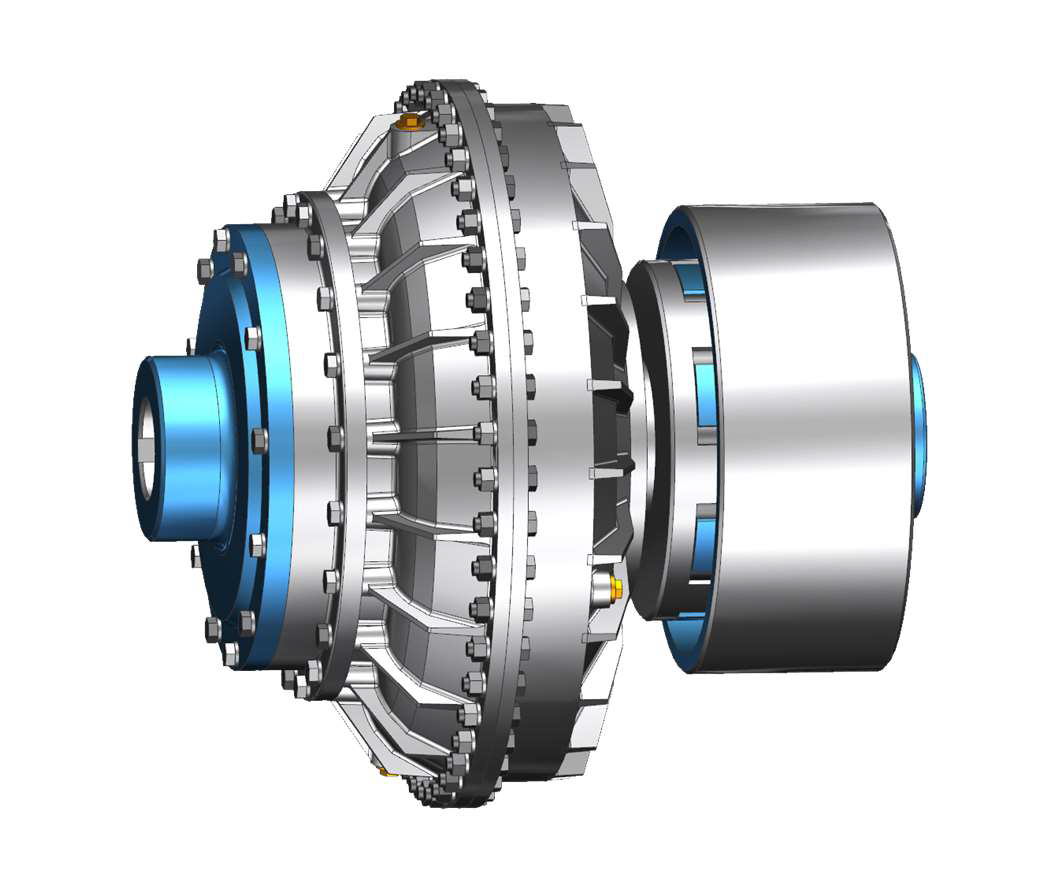
The Evolution of Technology: Constant-Fill vs. Variable-Speed
As a leading manufacturer specializing in high-efficiency power transmission solutions, Dalian Mairuisheng Transmission Mechanism Equipment Co., Ltd has observed a growing market trend toward more sophisticated fluid coupling configurations.
Engineers typically choose between two main type
s: constant-fill and variable-speed (or variable-fill) fluid coupling s.
Constant-Fill Fluid Couplings: These are the workhorses of standard conveyor applications. They offer a fixed torque transmission characteristic and are ideal for simple start-stop operations where the load is relatively consistent. They are valued for their simplicity, durability, and lack of external controls.
Variable-Speed Fluid Couplings: For complex conveyor systems requiring high precision, such as belt feeders or conveyors handling varying material densities, variable-speed fluid coupling s are the preferred solution. By utilizing a scoop tube to control the volume of oil in the working circuit, these devices allow for infinitely adjustable output speed independent of the motor speed. This capability enables "creep" speeds for inspection and maintenance, as well as perfectly tailored acceleration curves that match the specific load conditions, maximizing energy efficiency.
Industry Case Study: Mining and Port Logistics
In high-capacity port handling systems, where ship loaders and stacker-reclaimers operate around the clock, the reliability of fluid coupling technology is paramount. For instance, in a recent installation involving a 1,200-meter overland conveyor transporting iron ore, the integration of a fluid coupling resulted in a measurable reduction in belt splice fatigue and a 15% reduction in motor thermal stress during peak load periods.
The ability of the fluid coupling to act as a shock absorber during the sudden impact of large rock or aggregate falling onto the belt prevented the transmission of impact loads back to the drive head. This not only preserved the mechanical integrity of the gearbox but also ensured that the electrical network was not subjected to voltage dips caused by sudden load spikes.
Dalian Mairuisheng: Delivering Precision Power Transmission
For operations looking to retrofit existing conveyor systems or design new greenfield projects, sourcing high-quality fluid coupling technology is critical. Dalian Mairuisheng Transmission Mechanism Equipment Co., Ltd has established itself as a premier manufacturer in this specialized field. With a deep understanding of the rigorous demands placed on industrial conveyor systems, the company engineers fluid coupling solutions that prioritize durability, safety, and operational efficiency.
Their product portfolio encompasses a full range of hydrodynamic fluid coupling s designed to meet the diverse needs of the global market. Whether a client requires a robust constant-fill fluid coupling for a harsh mining environment or a high-precision variable-speed unit for a complex automated logistics center, Dalian Mairuisheng provides engineered solutions backed by rigorous quality control.
"Conveyor systems are the lifeblood of industrial production, and the fluid coupling is the heart that ensures that lifeblood flows smoothly," said a senior engineer from Dalian Mairuisheng. "Our focus is on providing fluid coupling s that not only meet international standards but exceed the operational expectations of our clients in terms of energy savings, longevity, and safety."
The company emphasizes the importance of selecting the correct fluid coupling based on specific application data, including motor power, conveyor length, load characteristics, and environmental conditions. Proper selection ensures that the fluid coupling operates at optimal efficiency, reducing energy losses associated with slip while maximizing protective capabilities.
The Future of Conveyor Drives
As the industrial sector moves toward Industry 4.0, fluid coupling technology is also evolving. Modern fluid coupling units are increasingly integrated with condition monitoring sensors. Parameters such as operating temperature, fill level, and output speed can now be transmitted to central control systems in real-time. This data allows for predictive maintenance, where potential issues are identified and addressed before they result in unplanned downtime.
Dalian Mairuisheng Transmission Mechanism Equipment Co., Ltd is at the forefront of this integration, developing fluid coupling solutions that offer seamless compatibility with modern automation systems. By combining robust mechanical design with smart monitoring capabilities, they are helping clients transition from reactive maintenance strategies to highly efficient predictive maintenance models.
Conclusion
The application of fluid coupling technology in conveyor systems represents a fundamental shift from reactive mechanical protection to proactive operational optimization. For any heavy industry reliant on material transport, the investment in a high-quality fluid coupling pays dividends through reduced electrical consumption, extended mechanical lifespan, and the elimination of costly production interruptions.
As global demand for raw materials and manufactured goods continues to rise, the efficiency of the conveyor systems that move these g
oods becomes increasingly critical. Through advanced fluid coupling solutions provided by manufacturers like Dalian Mairuisheng Transmission Mechanism Equipment Co., Ltd, industries can achieve the reliability and performance required to compete in the modern landscape.
About Dalian Mairuisheng Transmission Mechanism Equipment Co., Ltd
Dalian Mairuisheng Transmission Mechanism Equipment Co., Ltd is a specialized manufacturer dedicated to the research, development, and production of high-quality power transmission products, including a comprehensive range of fluid coupling s. With a commitment to engineering excellence and customer satisfaction, the company serves a global clientele across mining, metallurgy, power generation, and material handling sectors. Their expertise ensures that every fluid coupling delivered meets the rigorous demands of industrial applications.
For more information on selecting the right fluid coupling for your conveyor application, or to explore their full product line, please contact:
Dalian Mairuisheng Transmission Mechanism Equipment Co., Ltd
Email: info@mrscouplings.com
Website: https://www.mrscouplings.com