



How does a hydraulic coupling work?
2026-06-06 15:01How Does a Hydraulic Coupling Work?
A hydraulic coupling (also known as a fluid coupling) is a widely used power transmission device that connects two rotating shafts. It transmits torque through the flow of hydraulic fluid, offering smooth, continuously variable speed control without mechanical wear. Hydraulic couplings are commonly applied in conveyors, crushers, fans, pumps, and many industrial drive systems where soft start and overload protection are required.
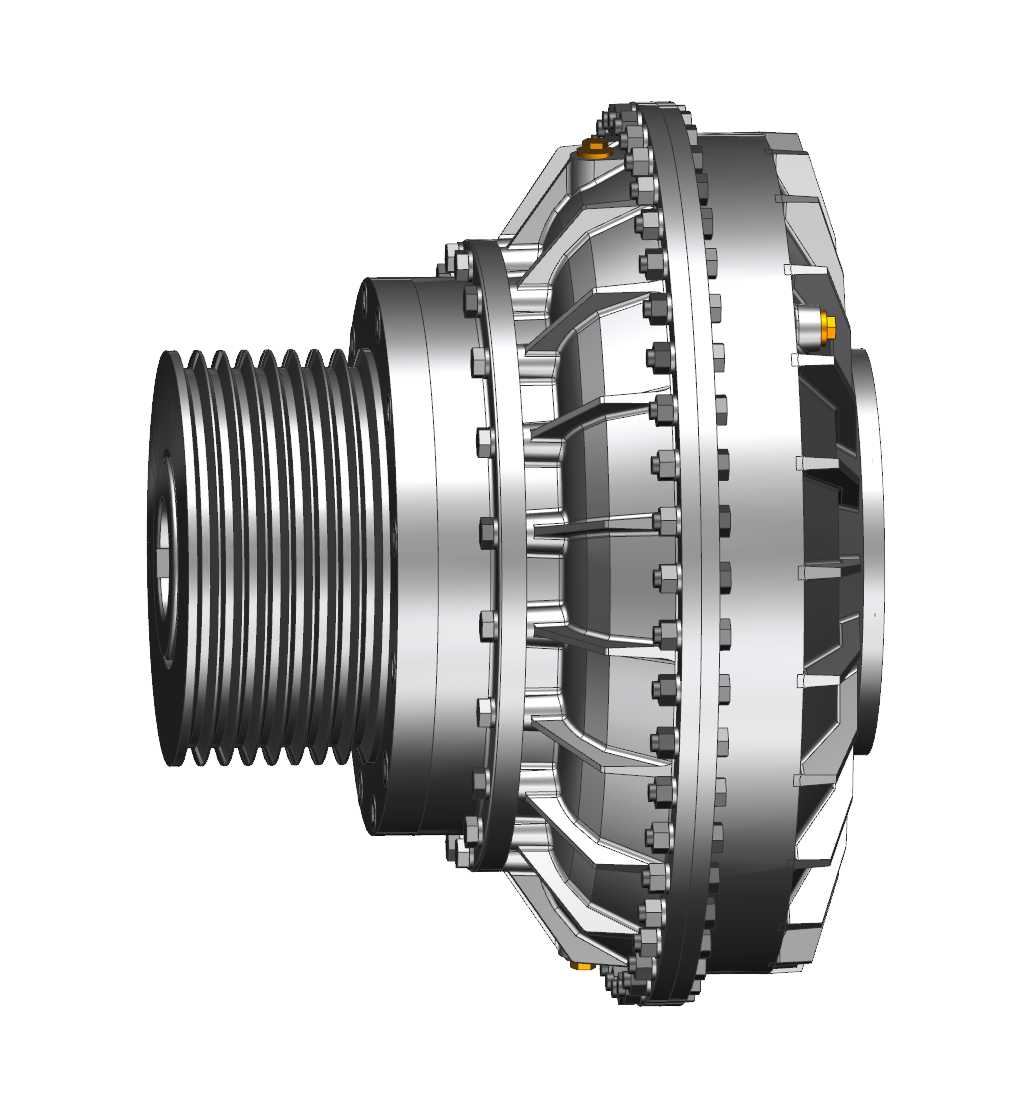
Main Components
A typical hydraulic coupling consists of three primary parts:
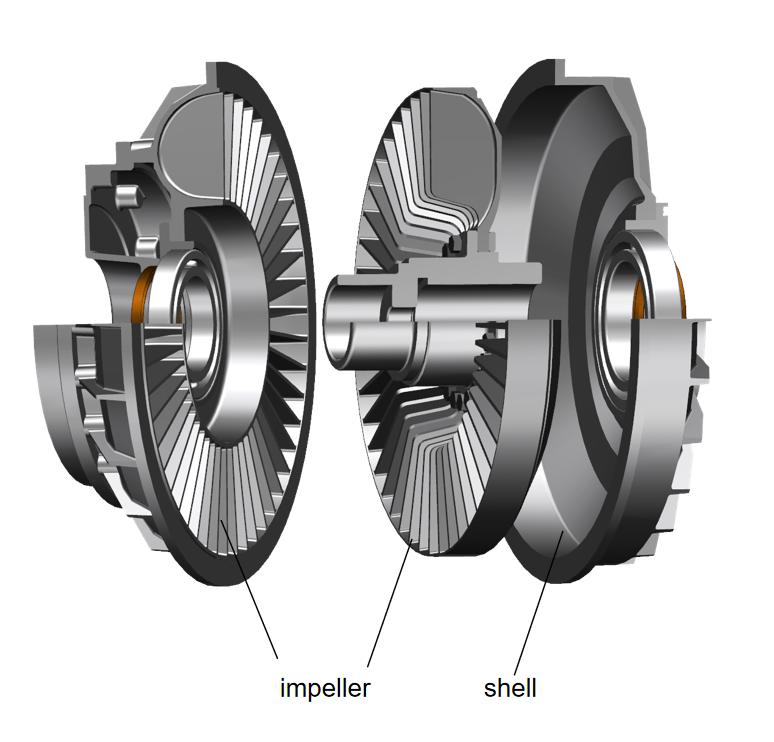
Pump wheel (impeller) – connected to the input shaft (motor or engine). It has radial blades that accelerate the hydraulic fluid outward when rotating.
Turbine – connected to the output shaft (driven machine). It also has blades that receive the fluid flow, converting kinetic energy back into torque.
Hydraulic fluid medium – usually high-grade hydraulic oil or transmission fluid that fills the working chamber. The fluid transfers energy from the pump wheel to the turbine.
Depending on the design, hydraulic couplings can be constant‑fill (fixed oil volume for torque limiting) or controlled‑fill (variable fill for speed control using a scoop tube or external valve).
Working Principle
The operation of a hydraulic coupling follows three distinct stages:
1. Starting Stage
When the motor starts, the pump wheel begins to rotate and pushes the fluid outward from its center. Initially, the fluid flow is weak, so the turbine receives only a small amount of kinetic energy. The turbine starts to rotate slowly, but the coupling transmits limited torque. During this stage, efficiency is low because most of the fluid energy is consumed in accelerating the fluid itself.
2. Acceleration Stage
As motor speed increases, the pump wheel spins faster, generating stronger fluid circulation. More fluid strikes the turbine blades, accelerating the output shaft. The torque transmitted rises progressively, and the coupling efficiency improves. This stage provides a “soft start” – the load accelerates smoothly without mechanical shock.
3. Steady‑State Stage
When the turbine speed approaches the pump wheel speed, the relative slip becomes small (typically 2–5%). The fluid flow reaches a stable equilibrium, and the coupling transmits nearly full torque with minimal loss. At this point, the hydraulic coupling operates at its highest efficiency, providing reliable power transmission with excellent vibration damping.
? Key principle: A hydraulic coupling transfers power hydrodynamically – there is no direct mechanical connection between input and output. This inherent slip gives it natural overload protection: if the load jams, the pump wheel can continue rotating while the turbine stalls, dissipating energy as fluid heat without damaging the motor or machine.
Types of Hydraulic Couplings
Constant‑fill couplings – have a fixed oil volume. They provide a fixed torque‑limiting characteristic and are ideal for belt conveyors, bucket elevators, and crushers.
Controlled‑fill couplings – allow the oil level to be varied during operation (using a scoop tube or external valve). They offer variable output speed and are used for fans, pumps, and centrifugal machines requiring flow control.
Delayed‑fill couplings – incorporate an additional chamber that fills slowly, extending the soft‑start time for very high inertia loads (e.g., ball mills, long conveyors).
Advantages of Hydraulic Couplings
Smooth, stepless speed variation – no clutch or gear shifting required, resulting in comfortable operation and reduced mechanical stress.
Soft start – eliminates shock loads during motor start‑up, protecting belts, chains, gearboxes, and bearings.
Overload protection – when the driven machine jams or overloads, the coupling slips, limiting torque and preventing motor stall or equipment damage.
Vibration and shock absorption – the fluid medium dampens torsional vibrations and impact forces from the load or motor.
High load‑carrying capacity – hydraulic couplings can handle large torque peaks and are suitable for heavy‑duty applications such as mining conveyors, crushers, and marine propulsion.
Low maintenance – no mechanical contact between driving and driven parts means little wear; only periodic oil changes and seal inspections are needed.
Typical Applications
Hydraulic couplings are extensively used in:
Mining and cement industry (belt conveyors, bucket elevators, crushers, mills)
Power plants (coal mills, fans, boiler feed pumps)
Material handling (stackers, reclaimers, ship unloaders)
Automotive and marine propulsion (limited applications, mostly in heavy vehicles)
Industrial fans, blowers, and centrifugal pumps